Bushy Park is like a patchwork quilt of English history.
It has remains of medieval farmland, a Tudor deer park, 17th century water gardens and wartime camps.
With over 445 hectares (1,099 acres) of land, Bushy Park is the second largest Royal Park in London and has an incredible range of wildlife and habitats within its walls.
Bushy became a royal park in 1529 when Cardinal Wolsey gave it to King Henry Vlll as part of a gift that also included Hampton Court. Until then, the park had been agricultural land. When the land was given to King Henry Vlll, he immediately created a deer chase. He built a brick wall around the park - and a section of this
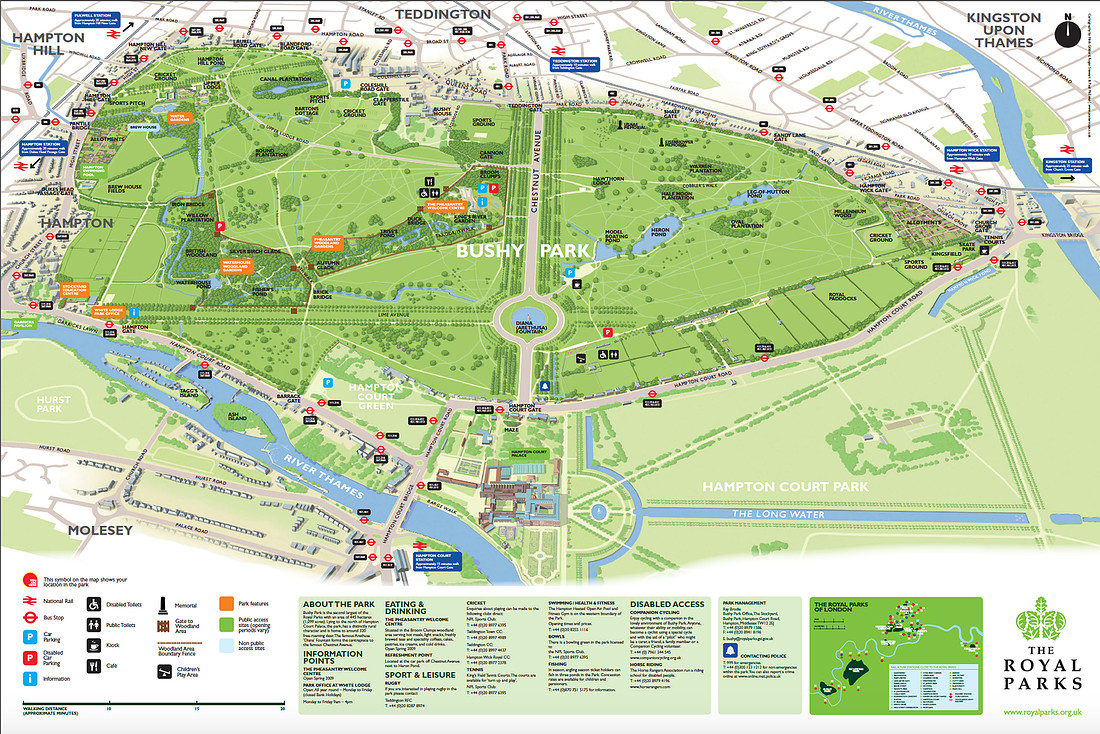
 remains along the north side of Hampton Court Road.
Deer continued to be hunted at Bushy throughout the 17th century - but the character of the park changed. In 1610, King Charles I created the Longford River - an ornamental canal, 19km (12 miles) long, which brought water from the River Colne in Hertfordshire to water features in the park. The canal was dug by hand but it now appears to be a natural part of the landscape and supports many plants and animals.
Houses were added to the park in the 17th and 18th centuries. These were used as hunting lodges and homes for the ranger. One of them, Bushy House, now belongs to the National Physical Laboratory. New gardens were also planted at this time. The most important are the Woodland Gardens in the south-east corner. They were created in the 20th century and include the Waterhouse and Pheasantry Plantations.
During World War 1, Canadian troops were stationed in the park and Upper Lodge became the King's Canadian Hospital, between the wars it hosted a camp for undernourished children. A totem pole was installed in 1992 in the Woodland Garden to remember this connection with Canada.
In World War 2, part of the park became Camp Griffiss, the base for the US 8th Army Air Force, US Strategic Air Forces and later the Supreme Headquarters Allied Expeditionary Forces. This was where General Eisenhower planned Operation Overlord, the code name for the allied invasion of north-west Europe that began with the D-D landings. Most of the camp's huts were removed by 1963 but you can still see remains of drain covers and stones poking through the grass. There are formal memorials to the USAAF and SHAEF in the north-east corner of the park.
Bushy Park is still a deer park today. Red and Fallow Deer still roam freely throughout the park, just as they did when Henry VIII used to hunt here.
There are currently about 320 deer in Bushy Park, and their grazing is essential to maintain the high wildlife value of the park's grasslands. Unlike cutting, grazing creates more variation in structure and plant diversity and does not damage the anthills, which add further diversity and character to the grassland.
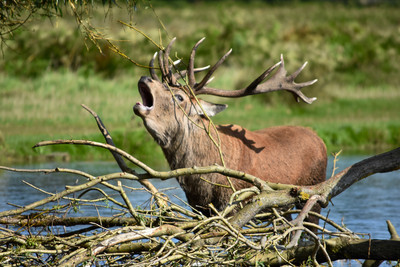 The herds are kept out of the Woodland Gardens and other protected plantations in order to protect the trees and shrubs there. The Red Deer are the largest mammal native to the British Isles and in the summer their coats are glossy red. Fallow deer, introduced by the Romans, are smaller and their summer coats, usually spotted, vary from a cream to darkish brown colour.
During the autumn the deer 'rut' (breeding season) takes place. The Red stags and Fallow bucks compete for females (known as hinds and does respectively). At this time, the large males roar, bark and clash antlers in a spectacular way in an attempt to fight off rivals and attract as many females as possible. The young are born May - July and are hidden by their mothers amongst the bracken and long grass. The young are very vulnerable at this time and their mothers, being sensitive to disturbance, will defend their babies.
Sources: The Royal Parks